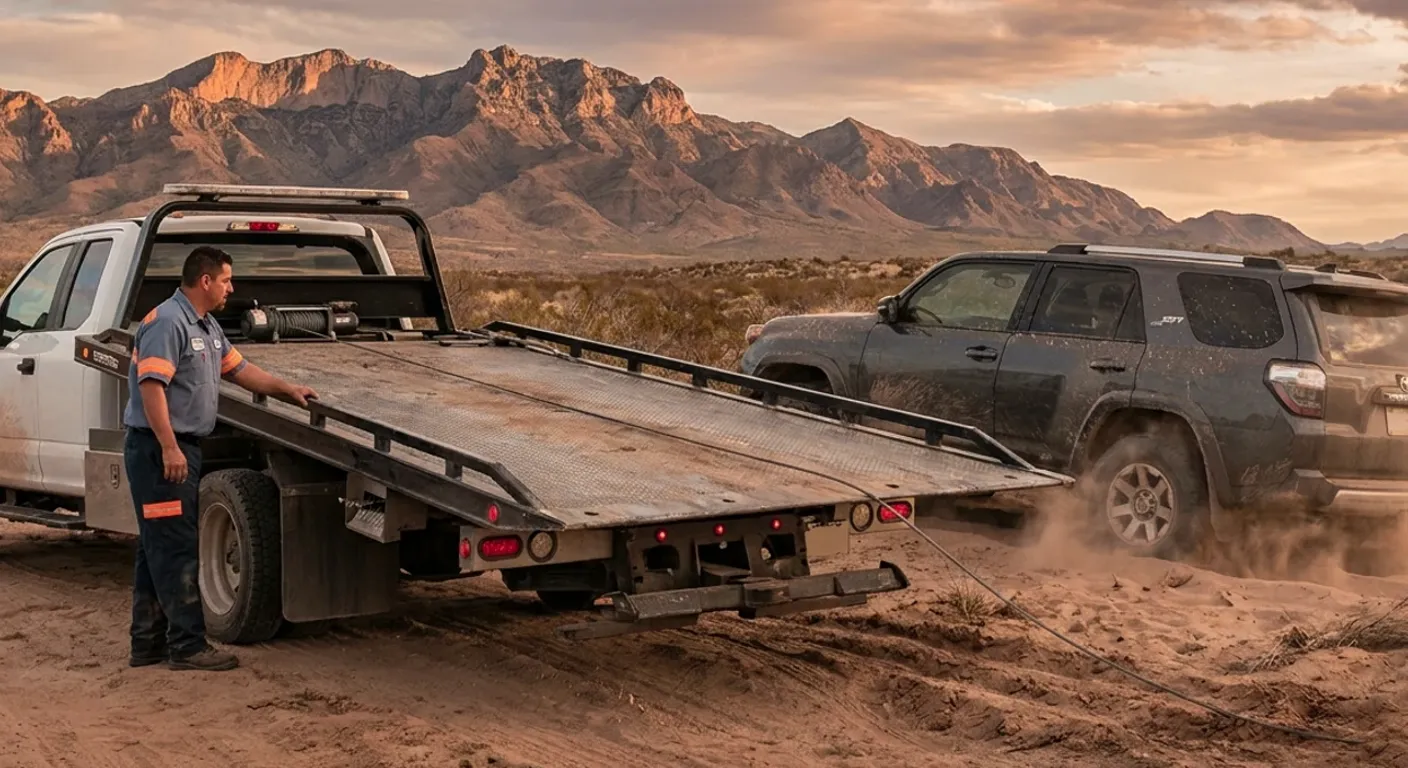
A winch out in Northwest El Paso starts with a clear description. The operator needs to understand where the vehicle sits, what surrounds it, and whether its wheels still move. Good details help the operator assess the job before arriving.
Share the exact location and surroundings
Start with the location shown on your phone. Give the street, nearby cross street, and direction of travel. If the vehicle is near I-10, Loop 375, Mesa Street, or Transmountain Road, name the route clearly. Loop 375 follows Transmountain on the north side of El Paso, so “Loop 375” alone may not narrow the location enough.
Explain whether you’re on a public street, beside a highway, or inside private property. A parking area, driveway, unpaved pull-off, and open roadside present different access questions. Mention any gate, curb, wall, parked vehicle, or narrow entrance between the street and your car.
A location pin helps, but don’t rely on it alone. Read the displayed address or coordinates to the operator. Then describe what you can see. A business name, marked entrance, intersection, or route sign can give the operator useful context. Don’t share personal information that has nothing to do with finding the vehicle.
State whether the vehicle remains on pavement. If it’s beyond the pavement, describe the visible surface. It might be loose dirt, packed ground, gravel, mud, or another surface. During El Paso’s July-to-September monsoon season, short, intense storms can cause flash flooding. Tell the operator about standing water or recently washed ground without guessing its depth.
Northwest El Paso remains inside El Paso city limits. Don’t confuse it with Sunland Park or Santa Teresa across the New Mexico line. The state and jurisdiction matter when an operator discusses the job, payment, or a possible tow afterward.
Describe how the vehicle is positioned
Next, explain the car’s position in ordinary words. The operator needs a picture of the whole vehicle, not just the stuck wheel. Say whether the vehicle faces toward the road, away from it, or across the edge of the pavement.
Describe which part left the firm surface. It may be one front wheel, both rear wheels, one side, or the entire vehicle. Note whether the car appears level, tilted, nose-down, or rear-down. If any part touches the ground, identify what you can see. Don’t crawl beneath the vehicle or diagnose damage you can’t confirm.
Distance also matters, but you don’t need a perfect measurement. Give a careful visual description instead. “The rear wheels are just past the pavement” is more useful than a guessed number. If you have a reliable measurement from a visible marker, tell the operator how you obtained it.
Mention nearby objects that limit the open space. These can include curbs, walls, fences, rocks, signs, parked cars, or landscaping. Tell the operator which side has the clearest approach. That isn’t a recovery instruction. It’s information the operator can use while assessing access.
If the vehicle entered the spot after a slide, collision, or mechanical problem, say so. Don’t describe it as a simple stuck-car call when there may be collision damage. A damaged wheel, leaking fluid, deployed airbag, or body panel touching the ground changes what the operator needs to evaluate. Report only what you can plainly observe.
Photos may help if the operator requests them. Take wide images that show the car and its surroundings. A close-up of one tire won’t show the full position. Avoid including faces, license documents, or unrelated personal details.
Explain what the wheels can still do
Tell the operator what happened when the car became stuck. Then explain what the controls and wheels can still do. Keep the description factual. You don’t need to identify the mechanical cause.
State whether the engine starts. Say whether the transmission selects drive, reverse, neutral, and park normally. Mention any warning shown on the dashboard. Quote the warning’s wording when possible instead of interpreting it.
Explain whether the steering wheel turns and whether the front wheels respond. Tell the operator if a wheel looks bent, flat, blocked, or out of alignment. If you can’t see a wheel, say that. An honest unknown is better than a confident guess.
The operator may also ask whether the parking brake releases. Report what the control indicates and what you observed. Don’t claim that a brake, axle, or transmission works merely because the vehicle starts.
Identify the vehicle accurately. Share the year, make, model, and body style if you know them. Say whether it’s a sedan, pickup, SUV, van, electric vehicle, or another type. Mention a trailer only if one is attached. Don’t estimate the vehicle’s weight or equipment requirements. The independent operator determines what the job calls for.
If spinning wheels dug into loose ground before the call, tell the operator. Describe the visible result without advising how the recovery should happen. For example, explain whether a tire sits below the surrounding surface or whether loose material has collected around it.
These details help separate a basic car-stuck request from a situation that may require winch-out and recovery or towing after the vehicle reaches firm ground. The operator can explain the proposed service after reviewing the vehicle’s condition and position.
Mention access and clearance concerns
A vehicle can be easy to locate but difficult to approach. Describe the path from the nearest paved entrance to the car. Mention narrow turns, low branches, locked gates, height restrictions, tight parking rows, or soft ground along that path.
If you’re in a garage or covered area, read any posted clearance marking to the operator. Don’t estimate it. State which level you’re on and whether the entrance and exit use different ramps. For private property, explain who controls access and whether permission is required.
Tell the operator about nearby traffic without making claims about traffic volume. Northwest El Paso connects with I-10, Mesa Street, and the Transmountain section of Loop 375. A car beside a corridor isn’t the same access situation as one inside a lot. Give the direction of travel and the nearest usable entrance when you know them.
Spring in El Paso is dust and wind season. If blowing dust is reducing visibility when you call, mention that current condition. During monsoon season, report visible runoff, standing water, or washed ground. Don’t predict whether the surface can hold a recovery vehicle. That assessment belongs to the operator.
Also disclose any obvious clearance issue around the stuck car. Open gates, movable vehicles, and stored materials may affect the available space. Don’t promise that an object can be moved unless you control it.
If the car is near the Texas-New Mexico line, confirm which state it’s actually in. Sunland Park and Santa Teresa are in New Mexico. Texas towing rules don’t apply there. No verified New Mexico dollar figure is available from the approved sources, so the operator must explain the applicable price and terms.
The clearer your access description, the fewer unanswered questions remain. If something isn’t visible, say so plainly.
Confirm the plan with the operator
Before the operator begins, ask what service is being proposed. A winch-out may end once the vehicle reaches a stable surface, or the car may also need towing. Don’t assume both services are included.
Quick Tow EP doesn’t perform recovery work or set prices. We connect callers with independent, separately licensed local tow operators. You deal with and pay that operator directly.
A winch-out requested by the driver is a consent service. The operator prices it, and the nonconsent tow cap table doesn’t set that price. Ask for the expected charges before the vehicle is hooked up. Confirm whether the discussion covers only recovery or also includes a tow to another location.
Inside El Paso city limits, City Code Chapter 12.54 governs nonconsent towing. Those rules concern tows ordered without the vehicle owner’s consent, such as certain police or private-property removals. They shouldn’t be treated as a price list for a recovery call you requested.
Confirm the destination if towing may follow. Give the operator the destination name and address. Don’t assume a shop is open, accepts the vehicle, or has agreed to receive it. Those details need separate confirmation.
Ask the operator to explain the plan before work starts. Point out any concern about visible body damage, wheel condition, clearance, or property access. If the situation differs from what you first described, update the operator before the work begins.
Texas requires towing companies and operators to hold licenses for the towing they perform on public roads. You can check an operator through the TDLR license search. Verification is especially useful when you’re dealing directly with a company you haven’t used before.
When to call us
Call when your vehicle is off the firm surface and needs assessment by a licensed towing professional. Call us at (915) 615-5465 and we’ll connect you with an independent licensed operator who handles this work. If nobody picks up, leave a voicemail.