To ask someone to tow your car in Spanish, say, “Necesito una grúa para mi carro.” In El Paso, clear details about your location, vehicle, wheels, and destination will help the independent operator understand the job.
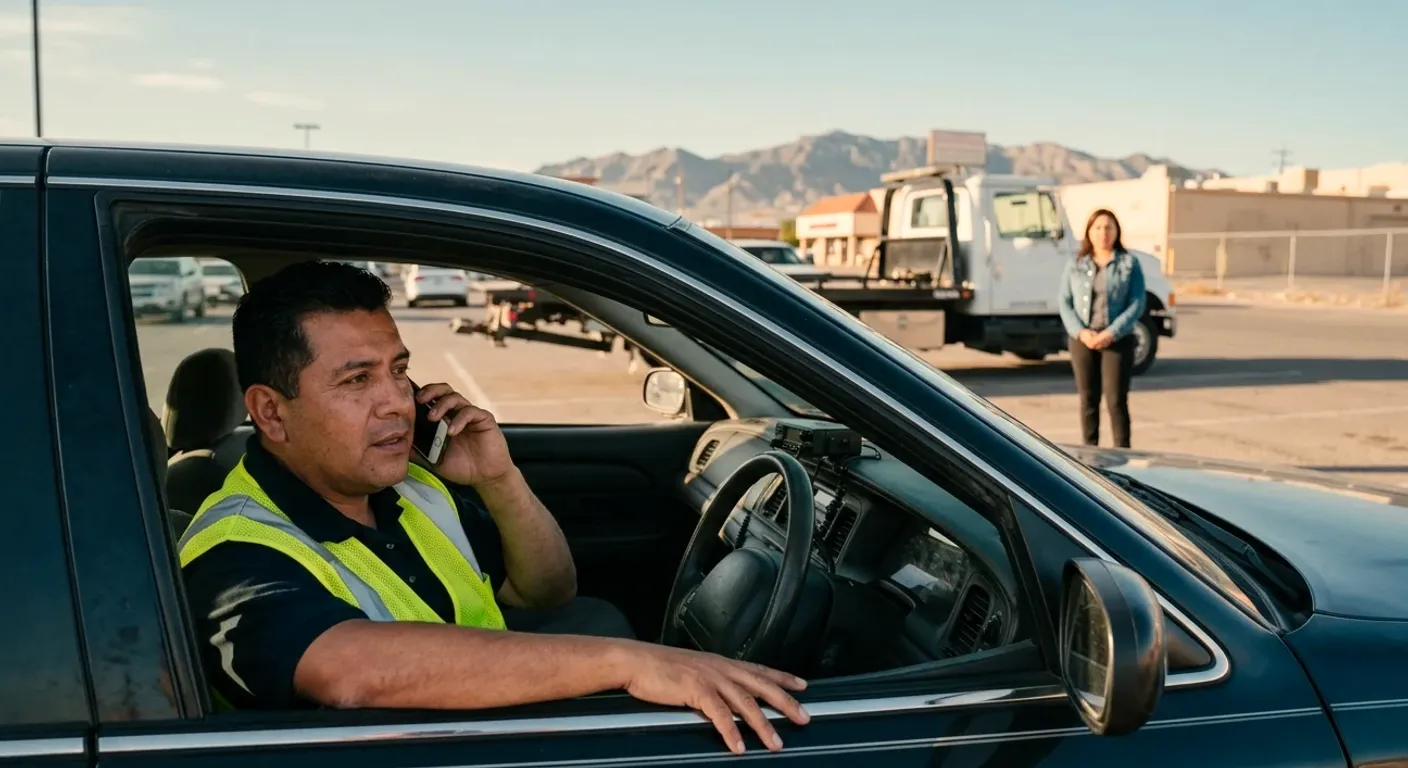
“Grúa” means tow truck and towing service in this context. If you searched “tow car in Spanish,” the most useful phrase is direct: “Necesito que remolquen mi carro.” You can also say, “Necesito una grúa,” which sounds natural on both sides of the El Paso and Ciudad Juárez border.
You don’t need perfect Spanish. Short phrases, nearby landmarks, and careful confirmation work better than a long explanation.
Describe where your carro is
Start with the exact place where the carro is waiting. Say the street, highway, business, or nearby exit first.
“Mi carro está en…” means “My car is at…”
Useful location phrases include:
- “Estoy en la I-10, cerca de la salida de Mesa Street.”
- “Estoy en Loop 375, cerca de Joe Battle.”
- “El carro está en un estacionamiento sobre Montana Avenue.”
- “Estoy cerca de Horizon Boulevard.”
- “Estoy en la orilla de la carretera.”
- “Estoy en el lado derecho de la carretera.”
- “Estoy en dirección al este.”
- “Estoy en dirección al oeste.”
Use “estacionamiento” for a parking lot. Use “orilla” for the roadside or shoulder in ordinary conversation. If you can see a business name or exit sign, read it exactly as shown.
Direction matters on divided routes such as I-10, Loop 375, and US-54. “Voy rumbo al centro” means you’re heading toward Downtown. “Voy rumbo a Las Cruces” identifies the opposite direction on I-10. Don’t depend on those phrases alone. Add an exit, cross street, or visible landmark.
Tell the operator if the carro is inside a garage, behind a gate, or in a tight parking space. You can say, “Está dentro de un estacionamiento” or “Hay poco espacio para entrar.”
State lines matter too. Sunland Park and Santa Teresa are in New Mexico, not Texas. Say the city and state clearly: “Estoy en Sunland Park, Nuevo México.” That prevents confusion with El Paso locations nearby.
Explain what happened to the vehicle
Next, describe the problem in one or two short sentences. You don’t need to diagnose the carro. Explain what happened and what it does now.
For a car that won’t start, say:
- “Mi carro no prende.”
- “El motor no arranca.”
- “La batería parece descargada.”
- “Se apagó y ya no volvió a prender.”
“Mi carro no prende” is common, plain border Spanish. “El motor no arranca” is more specific. If you only hear clicking, say, “Solo se escucha un clic cuando trato de prenderlo.”
For a crash or visible damage, try:
- “Tuve un choque.”
- “El carro está chocado.”
- “La defensa está suelta.”
- “Hay daño en la parte de enfrente.”
- “Hay daño en la parte de atrás.”
If the carro is stuck rather than broken, say, “El carro está atorado.” Add the surface when you know it: “Está atorado en lodo” means it’s stuck in mud. After a monsoon storm, don’t understate water around the vehicle. Tell the operator exactly what you can see.
Some problems may need roadside assistance instead of towing. A dead battery, flat tire, or empty tank doesn’t always mean the carro must go elsewhere. Describe the symptoms and let the independent operator discuss the appropriate service.
Don’t say the vehicle is safe to drive unless you know that. A better phrase is, “No sé si se puede manejar,” meaning, “I don’t know whether it can be driven.”
Share whether the wheels can move
Wheel condition changes how a vehicle can be loaded. Tell the operator whether the tires roll, the steering turns, and the parking brake releases.
Start with one of these phrases:
- “Las llantas sí ruedan.”
- “Las llantas no ruedan.”
- “Una llanta está ponchada.”
- “La rueda está doblada.”
- “El volante no gira.”
- “El freno de mano no se suelta.”
- “El carro está trabado en parking.”
In El Paso Spanish, “llanta” is the natural word for tire. “Ponchada” means flat or punctured. “Rueda” can describe the wheel as a complete part, especially when discussing visible damage.
Tell the operator which corner has the problem. Use “delantera” for front and “trasera” for rear:
- “La llanta delantera del lado del conductor está dañada.”
- “La rueda trasera del lado del pasajero no gira.”
- “Las dos llantas de enfrente están bloqueadas.”
Also identify the drivetrain if you know it. You can say, “Es de tracción delantera,” “Es de tracción trasera,” or “Es de tracción en las cuatro ruedas.” If you don’t know, say, “No sé qué tipo de tracción tiene.”
A damaged wheel, low-clearance vehicle, or locked drivetrain may affect the equipment chosen. If you mean a flatbed tow truck, ask, “¿Se necesita una grúa de plataforma?” The phrase “grúa flatbed” may be understood locally, but “grúa de plataforma” is clearer Spanish. You can review flatbed towing before discussing the vehicle’s loading needs.
Photos can help when the operator asks for them. Keep license plates, addresses, and personal information out of any image unless they’re necessary for identifying the carro or location.
Confirm the pickup and destination
A tow involves two locations. Confirm where the vehicle sits and where it needs to go. Don’t assume the person on the line heard either address correctly.
For the pickup, say, “La ubicación donde está el carro es…” Then give the full location. For the destination, say, “Quiero llevar el carro a…”
Useful confirmation phrases include:
- “¿Me puede repetir la dirección?”
- “¿Tiene bien anotada la ubicación?”
- “La dirección de destino es…”
- “Es dentro de El Paso.”
- “Es en Socorro, Texas.”
- “Es en Sunland Park, Nuevo México.”
- “Todavía no sé a qué taller llevarlo.”
Spell street names when pronunciation might cause confusion. “Mesa,” “Dyer,” “Alameda,” and “Socorro” may sound clear, but a numbered address can still be misheard. Say each digit separately when needed.
Be precise about jurisdictions. El Paso city limits, communities elsewhere in El Paso County, and New Mexico don’t share one towing-fee system. Sunland Park, Santa Teresa, Chaparral, and Anthony, New Mexico fall under New Mexico rules. Texas towing rules don’t apply there.
If the destination crosses the state line, state that before the operator accepts the job. Say, “El carro está en El Paso y va para Santa Teresa, Nuevo México.” For a longer trip within Texas, give both cities rather than saying it’s “far.”
If you haven’t selected a repair shop, say so plainly. The independent operator may need a confirmed destination before moving the vehicle. Don’t name a random shop just to finish the call.
Review charges with the independent operator
Quick Tow EP doesn’t set prices or quote totals. You’ll deal with and pay the independent operator directly. Before the truck hooks up, ask that operator to explain the proposed charges.
Natural phrases include:
- “¿Cuánto me va a cobrar?”
- “¿Qué incluye ese precio?”
- “¿Hay algún cargo adicional?”
- “¿El precio cambia por la distancia?”
- “¿Cómo puedo pagar?”
- “¿Me puede repetir el total?”
- “¿A nombre de quién hago el pago?”
Don’t assume a consent tow has the same rules as a police-ordered or private-property tow. A consent tow is one you request. The operator prices that job.
For nonconsent towing, jurisdiction determines which rules apply. Inside El Paso city limits, City Code Chapter 12.54 governs nonconsent towing fees. Outside the city limits in Texas, state rules apply unless a city or the county sets lower limits. New Mexico has its own rules, so Texas limits don’t carry across the state line.
If a stored vehicle was towed by El Paso police, use the El Paso Police Department vehicle-towing page to check the recovery process. For general Texas consumer rights and storage information, review the TDLR towing consumer guide.
You can also check a Texas towing operator through the TDLR license search. Select the tow-truck-operator license type, then search with the available name, city, county, ZIP code, or license number.
Keep the final exchange simple: confirm the service, pickup point, destination, proposed charges, and payment method. If anything sounds different from what you requested, stop and ask the operator to explain it again.
When to call us
Call when your carro can’t be driven safely and you need a licensed towing professional. Call us at (915) 615-5465 and we’ll connect you with an independent licensed operator who handles this work. If nobody picks up, leave a voicemail.