A licensed tow company performs the removal, but the approved claims ledger doesn’t confirm who may authorize every private-property tow. If you’re unsure whether you can authorize it, pause and confirm the current rules before anyone hooks up the vehicle.
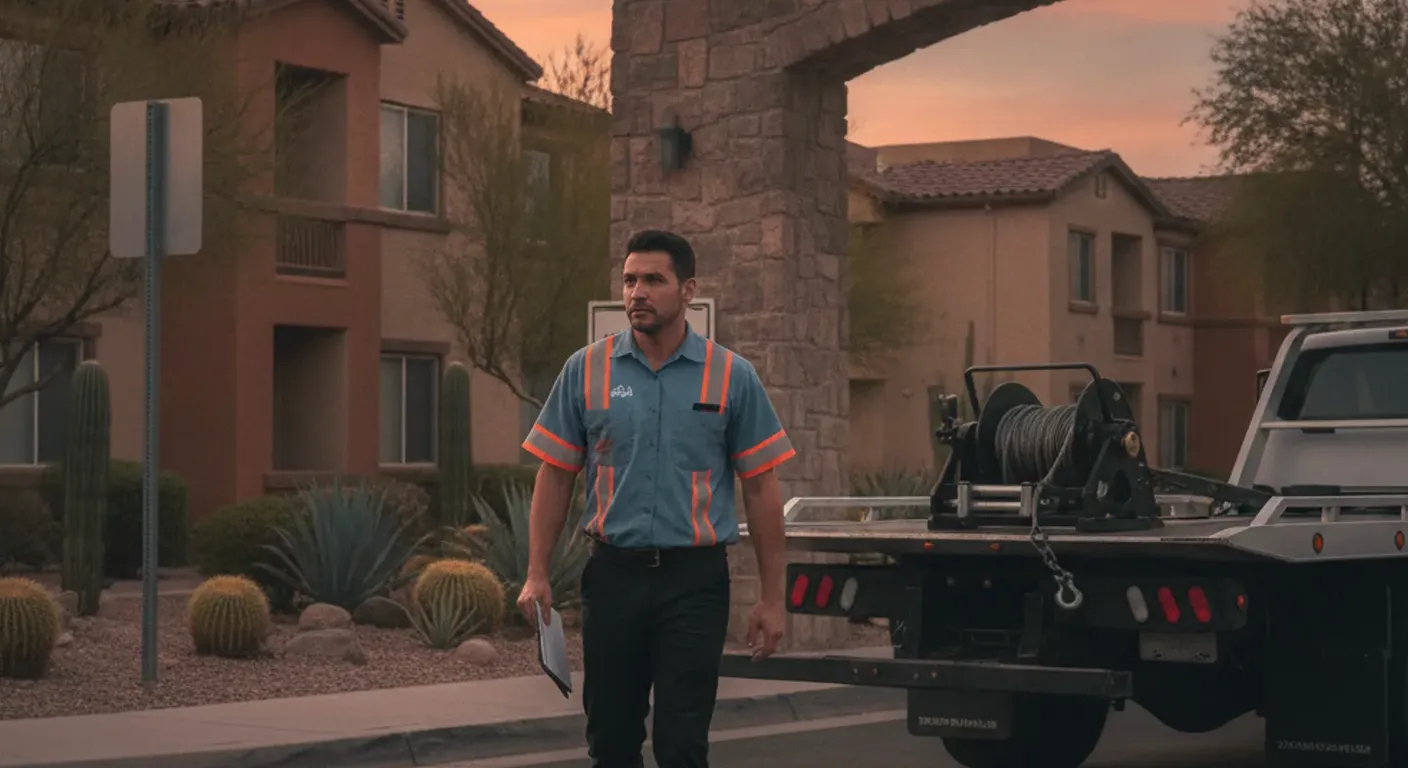
Texas licenses towing companies and operators based on the work they perform. Private-property removals are nonconsent tows because the vehicle owner didn’t request them. That makes the caller’s authority, the property’s location, and the operator’s license important.
El Paso adds another layer. Rules and fee limits change at the city boundary. Texas rules don’t carry across the state line into Sunland Park or Santa Teresa.
Determine whether you control the property
Start by identifying your connection to the parking area. Owning a nearby home doesn’t automatically establish control over an apartment lot, commercial driveway, shared alley, or public street.
Property owners should confirm that the vehicle sits within their parcel. Authorized managers should check whether their agreement lets them arrange a removal. Tenants, employees, HOA members, and neighbors shouldn’t assume they can approve a tow for someone else’s property.
The approved local records don’t confirm every authorization rule for apartments, HOAs, leased spaces, or commercial lots. They also don’t establish that a tenant can order a tow from a shared parking area. Ask the property owner, management company, or qualified attorney to confirm who may act.
Physical location matters just as much. A vehicle may look like it’s in your driveway while sitting partly within a public right-of-way. Don’t arrange a private tow until that boundary is clear. Contact the appropriate local law-enforcement agency when the vehicle is on a public street or when you can’t determine where private property ends.
Jurisdiction also changes across the El Paso metro:
- El Paso proper includes Downtown, the Westside, Northeast, East Side, Far East, Ysleta, and the Lower Valley.
- Socorro, Horizon City, Clint, Fabens, Canutillo, and unincorporated county areas sit outside El Paso city limits.
- Sunland Park, Santa Teresa, Chaparral, and Anthony, New Mexico, follow New Mexico rules.
- Fort Bliss uses installation rules for vehicles on post.
Give the operator the exact property address. A description like “near Loop 375” isn’t enough to identify the governing jurisdiction.
Document the vehicle and parking issue
Take clear photos before contacting a private-property towing operator. Capture the entire vehicle, its position, and the surrounding parking area. Include entrances, curbs, space markings, gates, and any signs already present.
Record what you can see without entering or touching the vehicle:
- Make, model, and color
- License plate and issuing state
- Parking-space number or nearby unit
- Date and time you found it
- How it affects access or assigned parking
- Visible damage or unusual condition
Keep your description factual. “Parked across the west driveway” is better than guessing why the driver left it there. Don’t open the vehicle, move its contents, or make claims about ownership.
Photograph every vehicle entrance if posted parking restrictions may matter. The approved El Paso claims ledger doesn’t confirm the exact sign wording, dimensions, placement, notice period, or exceptions required for this property. Don’t copy a sign template from another state. Rules from other states don’t establish what applies in El Paso.
Ask the Texas Department of Licensing and Regulation, the property owner’s attorney, or the appropriate city or county authority to confirm current requirements. Keep a record of the guidance you receive.
Documentation doesn’t make an unauthorized tow lawful. It gives the property representative and operator accurate facts to review. It can also help distinguish a parking dispute from a disabled vehicle, abandoned-looking vehicle, or blocked public access point.
Check the rules before arranging removal
Texas requires towing companies and operators to hold licenses suited to their work. You can check an operator through the TDLR license search by name, license number, city, county, or ZIP code. Select the tow-truck-operator license type when checking an individual.
A private-property tow is a nonconsent tow. Local governments may impose added registration requirements for that work. Ask the operator whether it can legally perform the removal in the exact jurisdiction you provide.
Don’t rely on a universal waiting period. The approved claims ledger doesn’t confirm one rule stating how long every vehicle must remain on private property before removal. It also doesn’t verify a general “80% rule” for private-property towing in El Paso. Ask the authority governing your property about signage, notice, authorization, and waiting requirements.
Fees also depend on location. Inside El Paso city limits, City Code Chapter 12.54.020 caps nonconsent towing at $100 for light-duty vehicles, $350 for medium-duty vehicles, and $450 for heavy-duty vehicles. The city allows up to $25 more for dollies or go-jacks. Different provisions may apply to vehicles over 10,000 pounds when work continues beyond two hours.
If the owner arrives before the vehicle is hooked up inside El Paso, the city rule allows no charge. If it’s hooked up but hasn’t left, the release charge is one-half of the applicable city tow fee.
Those El Paso figures don’t apply in Horizon City, Socorro, unincorporated El Paso County, or New Mexico. Outside El Paso city limits in Texas, statewide TDLR caps apply unless the city or county sets lower limits. No Texas fee applies in New Mexico. Confirm the governing rule before authorizing removal.
What an independent tow company may need
Expect the operator to ask who you are, where the vehicle sits, and why you believe you can request its removal. Have the property address and your documentation ready.
The operator may also ask about entrances, access, surface conditions, vehicle size, wheel position, and nearby obstructions. A tight apartment lot near Dyer Street presents different access concerns than an open commercial parcel near Montana Avenue. A gated property near Mesa Street may require different entry arrangements than a lot beside Alameda Avenue.
Don’t sign a blank form. Read any authorization before signing it, and keep a copy. Make sure the vehicle, property, and person authorizing the request are identified correctly.
Specific authorization forms, record-retention periods, police-notification steps, and sign requirements couldn’t be confirmed from the approved local ledger. Ask the licensed operator which documents it needs and which authority sets those requirements. If the explanation conflicts with guidance from TDLR or the local jurisdiction, stop and resolve the conflict first.
Quick Tow EP doesn’t approve the tow, determine legal authority, or set the operator’s price. We connect callers with an independent, separately licensed local operator. You deal with and pay that operator directly.
Before the vehicle is hooked up, ask the operator to explain:
- Whether it can accept the job in that jurisdiction
- What authorization or proof it needs
- Where the vehicle would be stored
- How the vehicle owner can identify the storage facility
- What the operator will charge
- Which local or state fee limit applies
Inside El Paso, the city’s nonconsent limits control. For a property outside the city, don’t assume those city figures follow the truck.
What to do when the vehicle blocks access
First determine whether the vehicle is entirely on private property. A car across a private apartment entrance isn’t necessarily handled the same way as one sitting on a public street in front of a driveway.
If any part of the vehicle is on public right-of-way, contact the appropriate law-enforcement agency before arranging removal. For a location inside El Paso, the El Paso Police Department vehicle-towing page is the relevant city resource. In unincorporated El Paso County, contact the county authority. On the New Mexico side, contact the agency for that New Mexico jurisdiction.
Don’t create a confrontation. Photograph the blocked entrance from a safe position. Note whether vehicles can enter or leave, but don’t exaggerate the situation. Avoid touching the parked vehicle or attempting to pull it away with another car.
If the driver returns, keep the exchange brief. Inside El Paso city limits, the release amount depends on whether the vehicle has been hooked up and whether it has left the property. No charge applies under the city rule when it isn’t yet hooked up. A hooked vehicle that hasn’t been towed from the scene must be released for half of the applicable city fee.
A vehicle that appears abandoned may involve a separate process. The approved ledger doesn’t confirm the notice period or removal procedure for every private property in El Paso. Report what you observe and ask the governing authority what process applies.
Location remains decisive. A blocked entrance near US-54 in Northeast El Paso falls under city rules when it’s within city limits. A similar problem near Horizon Boulevard in Horizon City is outside those limits. A property in Sunland Park falls under New Mexico law, with no Texas dollar figure attached.
When to call us
Call when you control the property, have documented the vehicle, and need to speak with a licensed towing professional about removal. Confirm your authority and the applicable local rules before the operator hooks up the vehicle.
Call us at (915) 615-5465 and we’ll connect you with an independent licensed operator who handles this work. If nobody picks up, leave a voicemail.