A Socorro towing call starts with a few precise details. Your location, vehicle condition, and planned destination help the operator understand the job before arriving. Quick Tow EP connects callers with independent, separately licensed local tow operators.
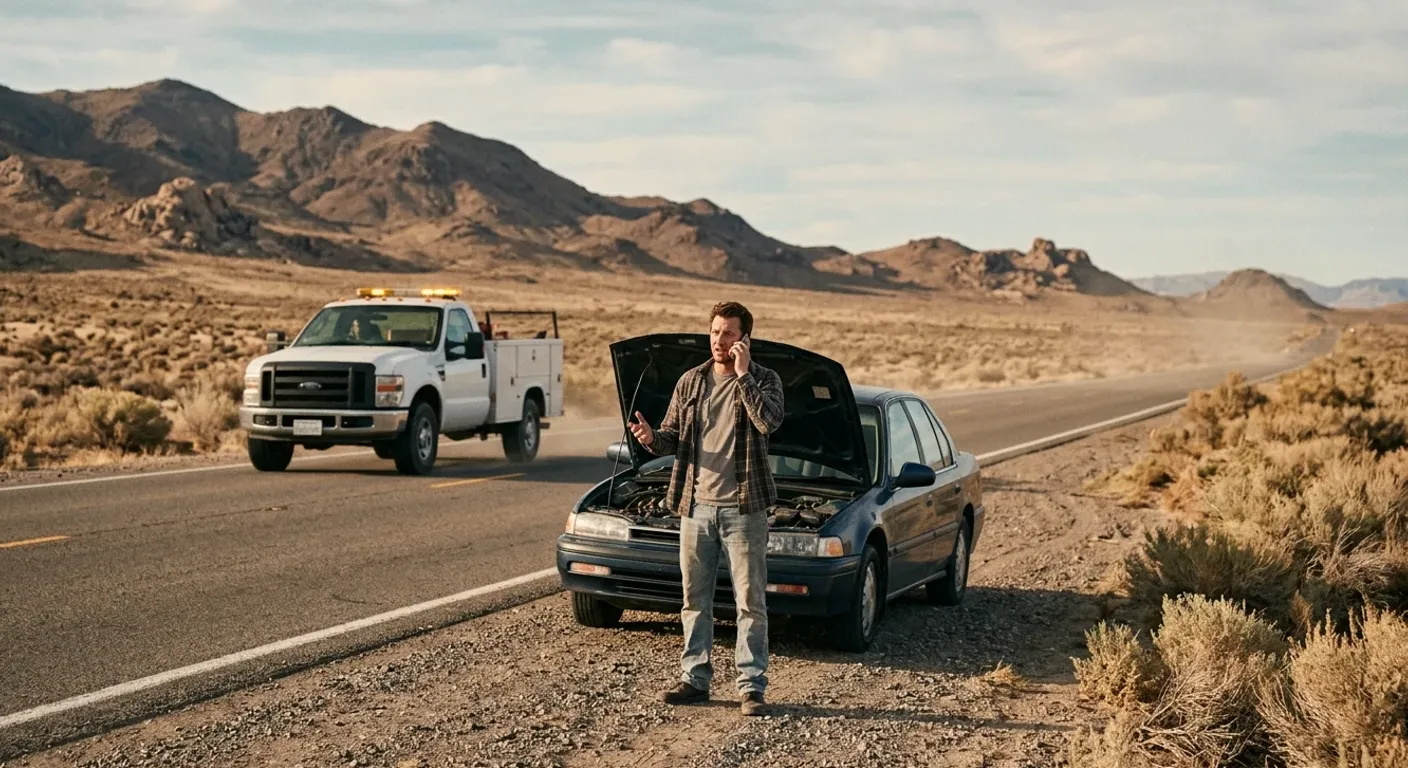
Share your exact location and direction
Start with the road name and your direction of travel. In Socorro, that might mean Socorro Road, also known as FM 258. It could also mean North Loop Drive, which is FM 76, or Horizon Boulevard, designated FM 1281.
A road name alone may leave too much room for confusion. Share a nearby cross street, business, entrance, or visible landmark when possible. If you’re using a navigation app, read the displayed address or send the location pin directly to the operator.
Direction matters on divided roads and highway approaches. Say whether you’re traveling toward I-10, toward Clint, or along the Socorro corridor. Don’t say only that you’re “near Horizon.” Horizon Boulevard connects Socorro, Sparks, and Horizon City before reaching I-10, so that description covers a broad area.
Explain where the vehicle is sitting. It may be in a driveway, parking area, travel lane, shoulder, or roadside ditch. Tell the operator whether there’s room beside it for a tow truck. Mention a gate, narrow entrance, deep shoulder, standing water, or blocked wheel if you can see one.
Don’t move into traffic to find a street sign. Stay somewhere protected and gather details from your phone or surroundings. During spring dust and wind, visibility can fall along El Paso County roads. Short, intense monsoon storms from July through September can also cause flash flooding. Never enter moving water to inspect the vehicle.
If your phone shows conflicting city names, tell the operator that too. A precise pin is more useful than guessing which mailing area applies.
Describe the vehicle and roadside problem
Give the operator the vehicle’s year, make, model, and color. Say whether it’s a car, pickup, SUV, motorcycle, RV, trailer, or commercial vehicle. Vehicle size and condition affect what equipment the independent operator may need.
Describe what happened without diagnosing a problem you can’t confirm. Useful descriptions include:
- The engine stopped and won’t restart.
- The battery appears dead.
- A tire is flat or damaged.
- The keys are locked inside.
- The vehicle ran out of fuel.
- The vehicle left the roadway.
- The wheels won’t turn.
- The vehicle was damaged in a collision.
Mention any warning lights, leaking fluid, smoke, or visible damage. Tell the operator if an axle, wheel, bumper, or body panel is touching the ground. If the steering is locked or the transmission won’t shift into neutral, say so.
Also identify anything that changes the vehicle’s height or weight. Examples include a loaded pickup, attached trailer, roof cargo, lowered suspension, or oversized tires. Don’t assume every tow truck can handle every setup. Let the operator decide what equipment fits the job.
For electric vehicles, share the model and battery condition. Tell the operator if the parking brake won’t release or the wheels appear locked. For all-wheel-drive vehicles, mention the drivetrain if you know it. You can ask whether flatbed towing or another towing method is appropriate.
A roadside problem may not require a tow. Describe the symptoms first, then ask whether roadside assistance could address them. The operator can discuss the requested work and its limitations directly with you.
Choose a safe pickup and destination
Your first priority is avoiding moving traffic. If the vehicle can be moved safely, place it away from active lanes. Turn on the hazard lights when appropriate. Don’t attempt to push a vehicle across a busy road or stand between it and approaching traffic.
Tell the operator about the pickup surface. A paved parking area differs from a soft shoulder, drainage area, farm entrance, or roadside slope. North Loop Drive runs through farmland and residential areas near Socorro. Much of the wider FM 76 study corridor is a two-lane, two-way rural road with narrow shoulders. A pickup there may need different positioning than one in a large parking lot.
Moving water is another concern during monsoon storms. About 12 inches of moving water can carry a small car. Don’t walk into floodwater or try to attach a strap yourself. Describe the water and vehicle position from a protected place.
Choose the destination before the operator hooks up when possible. You might need a repair shop, tire shop, dealership, home, or another lawful delivery point. Confirm that the destination accepts the vehicle. If the shop is closed, ask where the operator can legally leave it and whether someone must receive the keys.
Share anything that could affect access at either end. That includes gates, parking structures, low clearances, narrow driveways, or restricted entrances. Don’t promise access you haven’t confirmed.
If the vehicle was involved in a crash or ordered removed by law enforcement, follow the instructions given at the scene. A driver-requested tow and a police-ordered tow follow different pricing and release rules.
Confirm which jurisdiction applies
Socorro is outside El Paso city limits. That distinction matters because El Paso’s city towing caps don’t automatically apply to a tow that happens in Socorro.
A tow you request is a consent tow. The state nonconsent cap table doesn’t set its price. The independent operator prices the job, and you pay that operator directly. Quick Tow EP doesn’t set prices or quote totals.
For a nonconsent tow outside El Paso city limits in Texas, TDLR lists statewide maximum towing charges of $272 for vehicles weighing 10,000 pounds or less, $380 for vehicles weighing 10,001 through 25,000 pounds, and $489 per unit, up to $978, for vehicles over 25,000 pounds. Those figures apply outside El Paso city limits unless a city or county has adopted lower limits.
The approved records don’t confirm whether a lower Socorro-specific maximum applies. Check with the local government and TDLR towing consumer information before relying on the statewide ceiling.
For a nonconsent tow outside El Paso city limits, the maximum drop fees are $135, $190, and $244 for those same weight classes. A drop fee concerns a vehicle that’s fully hooked but hasn’t left the property. If the vehicle isn’t fully hooked when the owner returns, it must be released without charge, and no ownership proof is required.
Texas requires towing companies operating tow trucks on public roads to hold the applicable license. You can check an operator through the TDLR license search.
Don’t carry these Texas figures across the state line. New Mexico law governs tows in Sunland Park, Santa Teresa, Chaparral, and Anthony, New Mexico. No verified New Mexico dollar figure is available here, so contact the agency or storage lot that handled that tow.
Review payment details with the operator
Discuss the price directly with the independent operator before the truck hooks up. Explain the pickup location, destination, vehicle type, and condition first. Missing details can change the work required.
Ask the operator to explain how the charge is calculated. Confirm the expected towing distance and accepted payment methods. If the destination changes, discuss that change before the vehicle is moved. Quick Tow EP doesn’t collect payment or set the operator’s terms.
For a consent tow, don’t apply the TDLR nonconsent maximums as if they were a quote. Consent towing is priced by the operator. Ask about charges that may apply to the specific job, such as extra recovery work, specialized equipment, waiting, or storage. The operator should explain which items relate to your situation.
Make sure you know where the vehicle will be delivered. Write down the tow company’s name, the operator’s name, and the destination. Keep the receipt and any paperwork you receive.
If the vehicle goes to a Texas storage facility, retrieval requires identification, proof of ownership, and payment of towing and storage charges. Acceptable ownership documents can include registration-linked identification, an insurance card, title, notarized power of attorney, tax collector’s receipt, or lease agreement.
Texas storage facilities must allow free access to retrieve ownership documents and personal property from a stored vehicle. Payment isn’t required solely to collect those documents or belongings.
A vehicle removed or booted without consent may qualify for a tow hearing. The request must be filed within 14 days, excluding weekends and holidays, after storage or booting. A TDLR complaint doesn’t replace that hearing request.
When to call us
Call when a disabled, damaged, or immobile vehicle needs a licensed towing professional. Quick Tow EP is a referral line, so you’ll deal with and pay the independent operator directly. Call us at (915) 615-5465. The line may connect you with an independent, separately licensed local tow operator. If nobody picks up, leave a voicemail.