A Horizon City breakdown call goes better when your details are specific. Before requesting horizon towing, gather your location, vehicle information, roadside problem, and preferred destination.
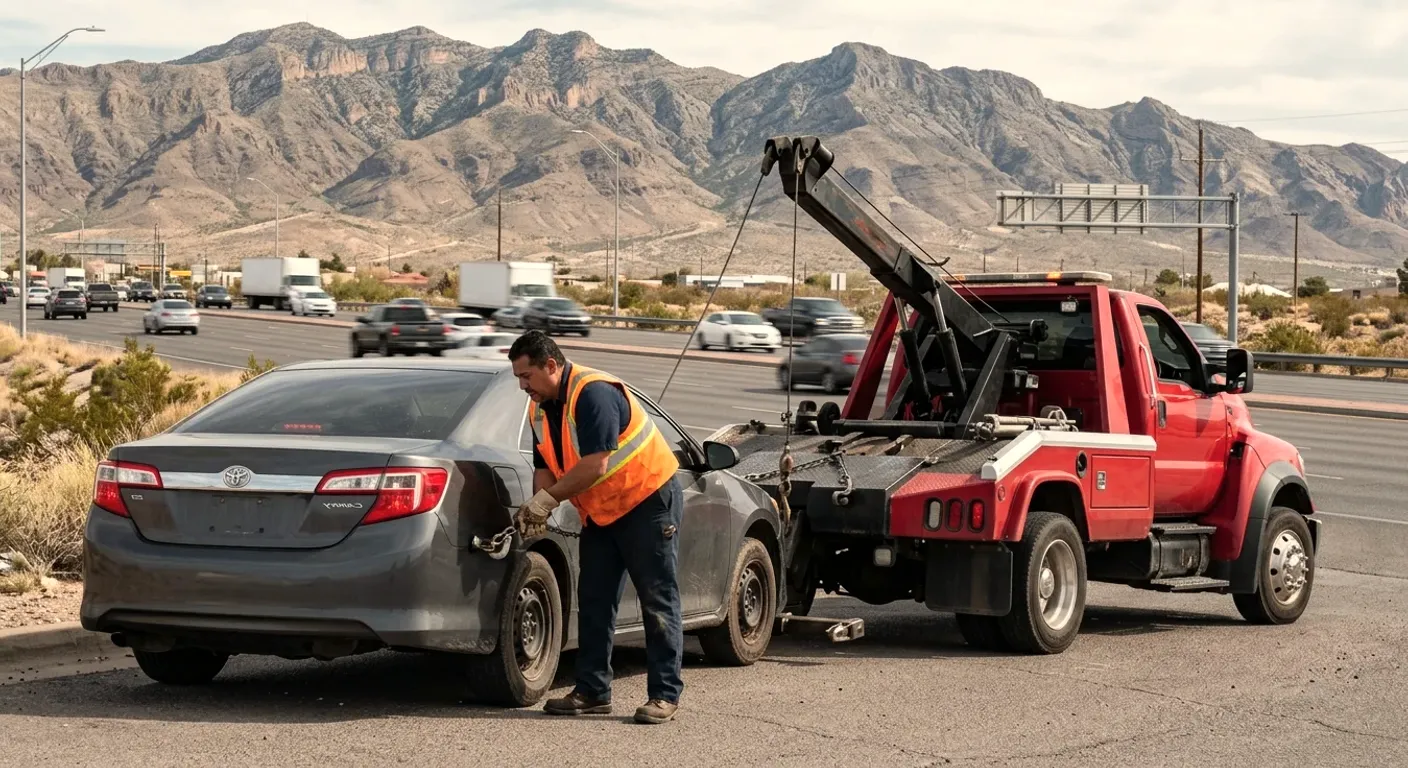
Share your exact location and direction of travel
Start with more than “Horizon City.” The operator needs a location that separates Horizon Boulevard from nearby Eastlake Drive, I-10, and the surrounding county roads.
Horizon Boulevard is also FM 1281. It’s the main commercial route through Horizon City and connects toward I-10 through Eastlake Drive. North Loop Drive is FM 76. That corridor begins near Horizon Boulevard and continues toward Socorro, Clint, and Fabens. Using both the road name and route number can prevent confusion.
Share these details when possible:
- The road name or parking-lot name
- Your nearest cross street or entrance
- Your direction of travel
- A dropped map pin
- The side of the road where you stopped
- A nearby business or visible landmark
- Whether the vehicle is in traffic, on a shoulder, or parked
A map pin is especially useful when nearby streets have similar names. Confirm that the pin marks the disabled vehicle, not your home or destination.
On I-10, include your travel direction and nearest exit. Don’t describe your location as “near Horizon” without more detail. The Horizon Boulevard area reaches I-10, and that description can cover very different pickup points.
If you moved after placing the call, tell the independent operator. Don’t assume a location update passed along automatically. You can also ask the operator for an arrival estimate, although Quick Tow EP doesn’t promise one.
Clear location details matter during dust and wind season. Low visibility can affect I-10 travel during March and April. During monsoon season, July through September, short storms can also change roadside conditions quickly.
Describe the vehicle and roadside problem
Tell the operator exactly what needs to be moved. Start with the vehicle’s year, make, model, color, and approximate size. Mention whether it’s a car, pickup, motorcycle, RV, trailer, or commercial vehicle.
Next, describe the problem in plain words. Useful details include:
- The engine won’t start
- The vehicle has a flat tire
- A wheel or axle appears damaged
- The vehicle was in a collision
- The steering is locked
- The transmission won’t shift into neutral
- The vehicle is stuck off the pavement
- The keys are missing or locked inside
- The vehicle is electric
- A trailer is attached
Don’t diagnose the failure if you aren’t sure. “The front-left wheel won’t turn” is more useful than guessing that the transmission failed. The operator can decide what equipment may fit the situation.
Tell the operator if the vehicle has low clearance, all-wheel drive, oversized tires, damaged suspension, or loose body panels. Also mention tight parking access, a locked gate, underground clearance, or a narrow driveway. Those details can affect whether flatbed towing or another towing method is appropriate.
If the vehicle left the pavement, explain the surface. Sand, mud, a drainage area, and a paved shoulder aren’t the same pickup. Don’t attempt to drive through moving floodwater. About 12 inches of moving water can carry a small car.
For a dead battery, flat tire, lockout, or empty fuel tank, ask whether roadside assistance may address the immediate problem. The independent operator determines what work is suitable. Quick Tow EP doesn’t own equipment or perform repairs.
Choose a safe pickup and destination
Describe the vehicle’s position before discussing where it should go. If it can be moved out of a travel lane without creating more risk, choose a visible place away from moving traffic. Don’t attempt to push or reposition a damaged vehicle when doing so would put you in the road.
Texas law requires approaching drivers to change lanes or reduce speed for a stationary permitted tow truck using proper visual signals. The lane-change requirement applies on roads with at least two lanes moving in the same direction. If a lane change isn’t made, drivers must slow according to Texas Transportation Code Section 545.157. Violating that requirement is an offense.
The destination also needs to be specific. Give the operator the business name, street address, and any entrance instructions. Confirm that the destination can receive the vehicle. Quick Tow EP can’t confirm another business’s hours, storage rules, or after-hours access.
Possible destinations include:
- A repair shop selected by the driver
- The driver’s home
- A dealership
- A tire shop
- A storage facility
- Another location approved by the vehicle owner
Ask whether the vehicle and keys can be left there. If someone else will receive the vehicle, share that person’s name and contact details directly with the operator.
Distance changes the job. A pickup near Horizon Boulevard with a destination elsewhere in Horizon City differs from a tow into El Paso, toward Clint, or across the New Mexico state line. Give both addresses before the truck hooks up.
TxDOT’s El Paso HERO program covers I-10 from Transmountain Road to Horizon Boulevard during its published operating hours. It provides free highway help and can move a stranded vehicle from a travel lane or shoulder, but it isn’t a tow to a repair shop.
Confirm which jurisdiction applies
Horizon City is outside El Paso city limits. That distinction controls which nonconsent towing limits may apply.
A consent tow is one the driver requests. The state nonconsent cap table doesn’t set the price for that job. The independent operator prices it, so confirm the expected charges before the truck hooks up.
For a nonconsent tow outside El Paso city limits in Texas, TDLR lists statewide maximums of $272 for vehicles weighing 10,000 pounds or less, $380 for vehicles from 10,001 through 25,000 pounds, and $489 per unit, up to $978, for vehicles over 25,000 pounds. Those figures apply outside El Paso city limits unless Horizon City or El Paso County sets a lower maximum.
No lower Horizon City figure was confirmed in the approved records for this page. Check the current rule with Horizon City, El Paso County, or TDLR towing consumer information before relying on a maximum.
Outside El Paso city limits, TDLR’s maximum drop fees are $135, $190, and $244 for those same three weight classes. A drop fee applies when a vehicle is fully hooked but hasn’t left the property. If it isn’t fully hooked when the owner returns, retrieval must be allowed without charge or ownership proof.
Don’t apply those figures to El Paso proper. Inside El Paso city limits, City Code Chapter 12.54 sets different nonconsent limits. It caps light-duty towing at $100, medium-duty towing at $350, and heavy-duty towing at $450. Different rules also apply when the owner arrives before the vehicle leaves.
Texas towing limits don’t apply across the state line. Sunland Park, Santa Teresa, Chaparral, and Anthony, New Mexico, fall under New Mexico law. No verified New Mexico dollar figure is available for this page. Contact the agency or storage facility responsible for that tow.
Review payment details with the operator
Quick Tow EP is a referral line, not the tow company. We connect callers with an independent, separately licensed local tow operator. The driver deals with and pays that operator directly.
Before the vehicle is hooked up, ask the operator to explain the expected charges. Quick Tow EP doesn’t set prices or quote totals. For a driver-requested consent tow, there’s no approved cap table to publish here.
Confirm details such as:
- The pickup and destination addresses
- The service being discussed
- How distance affects the charge
- Whether special equipment may add a charge
- Which payment methods the operator accepts
- When payment is due
- What happens if the destination can’t receive the vehicle
Don’t assume a price includes storage, recovery work, extra stops, or moving a trailer. Describe the whole situation first. Then ask the operator what applies to that job.
For a nonconsent tow, keep the signs, notices, receipts, and photographs connected to the removal. Texas vehicle owners and operators may request a hearing about probable cause for a nonconsent tow or boot. The request must be filed within 14 days, excluding weekends and holidays, after the vehicle enters storage or is booted. A TDLR complaint doesn’t replace that hearing request.
Texas requires towing operators and towing companies working on public roadways to hold the applicable licenses, subject to specific statutory exemptions. You can check an operator through the TDLR license search using a name, license number, city, county, or ZIP code.
When to call us
Call when a disabled, damaged, or stuck vehicle needs a licensed towing professional in Horizon City. Have your map pin, vehicle details, destination, and roadside conditions ready.
Call us at (915) 615-5465 and we’ll connect you with an independent licensed operator who handles this work. If nobody picks up, leave a voicemail.