A breakdown in Northeast El Paso can leave you choosing between several kinds of tow help. Before calling, gather the location, vehicle condition, and preferred destination so an operator can assess the job.
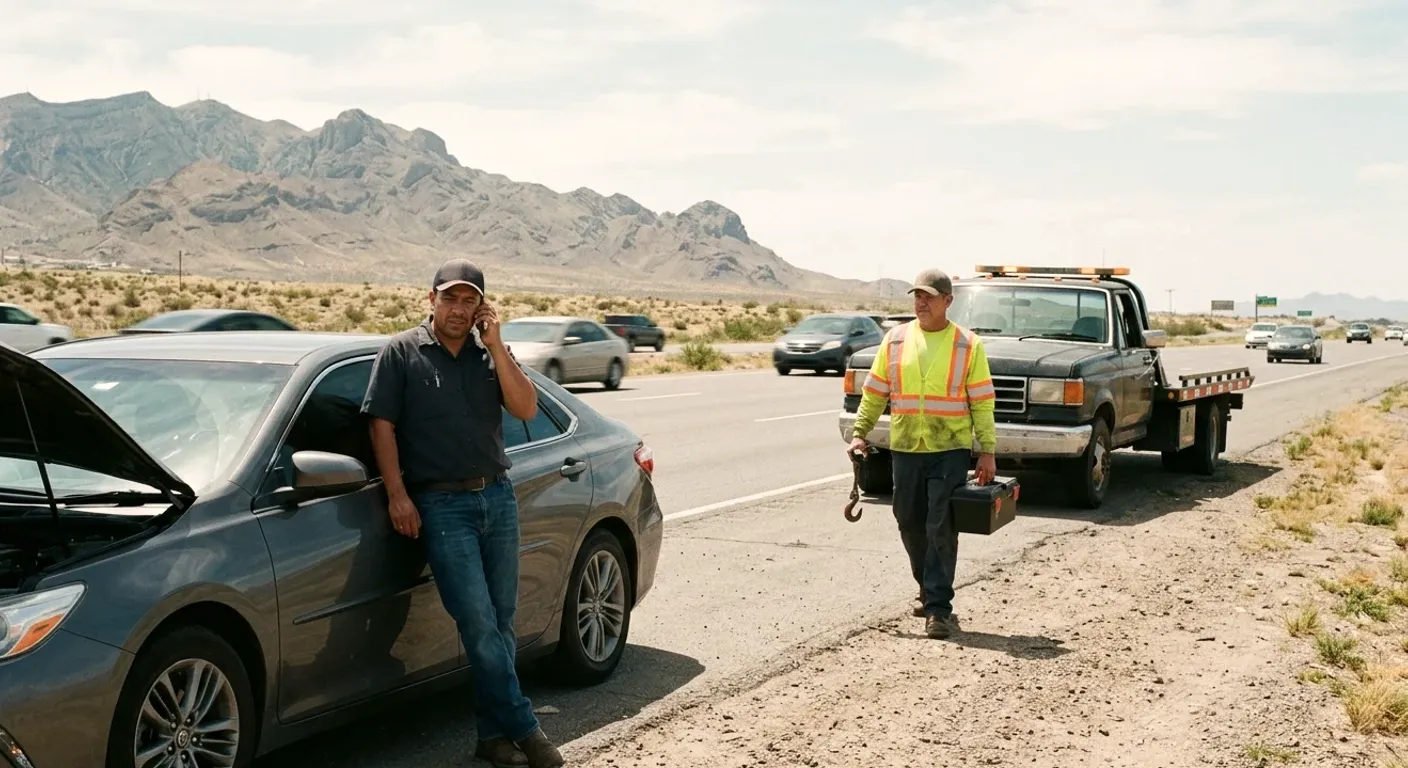
Pinpoint your location before making the call
Start with the road name and your direction of travel. Northeast El Paso includes major corridors such as US-54 Patriot Freeway, Loop 375, Dyer Street, and McCombs Street. Spur 601 also connects this part of the city with Fort Bliss and central El Paso.
A dropped map pin is often more useful than a neighborhood name. Share the nearest exit, cross street, business, or visible landmark. If you’re on a divided road, say which direction you were traveling. That detail can affect how an operator approaches your vehicle.
Don’t describe every northeastern location as simply “near the freeway.” US-54 and Loop 375 cover different paths. Loop 375 also changes local names around El Paso. Its northern segment is known as Transmountain, while the eastern segment is Joe Battle. Naming the road shown on your map helps prevent confusion.
The Northeast also differs from central El Paso and the Westside. A shop near Downtown, Mesa Street, or I-10 may require a different route than one near Dyer Street or US-54. Pickups involving Fort Bliss need another distinction. Tell the operator whether the vehicle is on post or on an off-post city street. Installation rules govern towing on Fort Bliss, while El Paso city rules apply on city streets.
When looking for a tow truck in Northeast El Paso, share the most precise location you have.
Explain whether the car can roll or steer
A towing operator needs more than the car’s make and model. Explain what happened and what the vehicle can still do. The condition of its wheels, steering, and transmission affects how the operator evaluates the pickup.
Tell the operator whether the car:
- Rolls freely or has a locked wheel
- Steers normally or has damaged steering
- Starts and shifts into neutral
- Has a flat tire or damaged wheel
- Sits level or rests against a curb
- Has visible damage after a collision
- Is stuck off the paved surface
- Has low ground clearance
- Is an electric, all-wheel-drive, or four-wheel-drive vehicle
Describe what you already know. If warning lights appeared before the breakdown, mention them. If the vehicle leaked fluid, say where you noticed it. The operator can then decide what information or equipment the job requires.
Weather can also change the situation. El Paso’s monsoon season runs from July through September and can bring short, intense storms and flash flooding. About 12 inches of moving water can carry a small car. Don’t enter moving water to inspect or retrieve a vehicle.
Spring dust and wind can reduce visibility on I-10. If blowing dust affects your location, tell the operator during the call. Summer heat also shortens battery life. A no-start may need roadside assistance instead of a tow, but the operator should make that assessment from the symptoms you provide.
Clear details help avoid a mismatch between the vehicle’s condition and the towing method.
Match the problem to the towing method
Wheel-lift towing raises one end of a vehicle while the other wheels remain on the road. It can be a practical option for many ordinary passenger vehicles when the drivetrain, wheel condition, and pickup location allow it.
That doesn’t make it the right method for every breakdown. A locked wheel, collision damage, low clearance, or drivetrain requirement may change the operator’s recommendation. Ask whether wheel-lift towing fits your vehicle before it’s connected.
A flatbed carries the vehicle with its wheels off the roadway. Operators may consider it when a vehicle can’t roll normally or when its condition calls for full loading. Electric cars, specialty vehicles, and badly damaged cars may have manufacturer instructions that affect transport. Share the exact year, make, model, and drivetrain when you know them. Don’t assume every tow truck can handle every vehicle.
Larger vehicles need separate evaluation. A pickup, work truck, RV, trailer, or commercial vehicle may require equipment chosen for its size and weight. Don’t describe a loaded work truck as an ordinary light-duty pickup. Tell the operator about attached trailers, cargo, modifications, or missing wheels.
A roadside problem may not require towing at all. A flat tire, weak battery, empty fuel tank, or lockout could call for roadside assistance. TxDOT’s El Paso HERO program also provides free highway help on covered portions of I-10, Loop 375, and US-54 during its published operating hours. HERO can change a tire, provide fuel or water, perform a jump start, make minor repairs, or move a stranded vehicle out of a travel lane. It isn’t transportation to a repair shop.
Choose a practical drop-off destination
Decide where the car should go before the operator arrives. Common choices include a repair shop, dealership, tire shop, home, or another lawful private location. Confirm that the destination accepts the vehicle before arranging the tow.
Location matters in Northeast El Paso. A destination along Dyer Street or US-54 may keep the car in the same part of town. A shop near central El Paso, I-10, or Mesa Street places it across a different corridor. A Westside destination may require travel around or across the Franklin Mountains. These differences don’t justify guessing an arrival time or total. They do help the independent operator understand the requested trip.
Ask the destination several practical questions:
- Will it accept an unattended vehicle?
- Where should the operator leave the car?
- Does it need the keys?
- Is there a locked gate?
- Does the shop service your vehicle type?
- Do you need to complete paperwork first?
If the vehicle was involved in a crash, don’t assume it can go home or to your preferred shop. Follow instructions from the officer or agency controlling the scene. El Paso law also restricts unsolicited towing at crash and incident-management scenes. Under City Code Section 12.54.070, a truck must first be contacted by police, the owner, the driver, or the insurer before performing that nonconsent or incident-management tow.
A vehicle already removed by police may be at the City of El Paso Municipal Vehicle Storage Facility. Use the El Paso Police Department vehicle-towing page to find the current recovery instructions. That process is separate from arranging a consent tow for a disabled vehicle.
Confirm charges with the independent operator
Quick Tow EP doesn’t set prices or quote totals. The independent operator sets the charge, and you pay that operator directly. Confirm the proposed charge and payment terms before the truck hooks up.
For a consent tow, meaning one you request yourself, the El Paso nonconsent cap table doesn’t set the price. Ask what factors affect the total, including the vehicle type, towing method, pickup conditions, and destination. If something changes after the operator sees the vehicle, ask for an explanation before authorizing additional work.
Different rules apply when a tow happens without the owner’s consent. Inside El Paso city limits, City Code Section 12.54.020 caps nonconsent towing at $100 for a light-duty vehicle, $350 for a medium-duty vehicle, and $450 for a heavy-duty vehicle. The code allows up to $25 more for dollies or go-jacks. Vehicles over 10,000 pounds may also incur up to $55 per hour for each hour beyond two hours at the scene, plus the actual cost of cargo moved by hand.
If the owner or driver reaches the vehicle before removal, the same city section matters. There’s no charge when the vehicle hasn’t been hooked up. If it’s hooked up but hasn’t been towed from the scene, the release charge is one-half of the applicable city fee.
These El Paso city figures don’t apply outside city limits or in New Mexico. They also don’t set the price of a consent tow. For general Texas consumer rules, review the TDLR towing information. You can also check an operator through the TDLR license search.
When to call us
Call when a disabled or damaged vehicle needs evaluation by a licensed towing professional. Call us at (915) 615-5465 and we’ll connect you with an independent licensed operator who handles this work. If nobody picks up, leave a voicemail.