A car with locked wheels may still be towable, but the answer depends on its exact condition. The operator needs to know which wheels are locked, whether the car steers, and how much working space surrounds it.
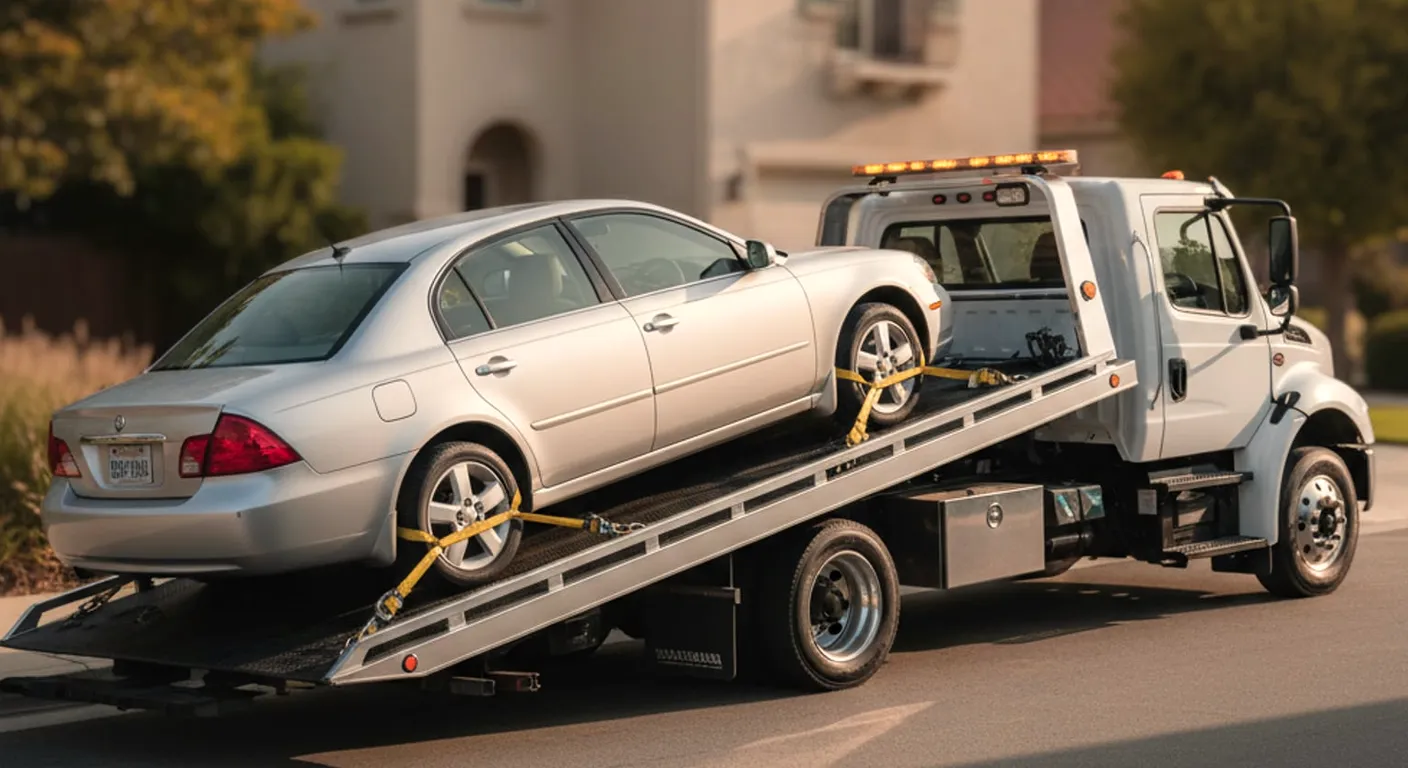
Don’t try to make the car roll before that conversation. Describe what you can observe, then let the independent operator decide whether the vehicle and location can be handled.
Describe which wheels won’t move
Start with the simplest useful detail: identify which wheels won’t turn. Tell the operator whether the problem affects one wheel, two wheels, or all four. If two are locked, say whether they’re at the front, rear, or on one side.
You don’t need to diagnose the cause. A short description works better than a guess. For example, say that the left rear wheel stays still when the car is shifted, or that both front wheels appear unable to rotate. Mention whether the car moved before the wheels stopped.
Only report what you’ve already observed. Don’t drag the car, push it into traffic, or force a wheel to test it. Scraping, resistance, or a wheel sitting at an unusual angle are details to share with the operator.
Also explain whether the parking brake is engaged or whether its indicator appears on. If the controls don’t respond, say that. If the keys are missing, locked inside, or damaged, include that information too. Those facts help the operator understand the condition without you attempting a roadside repair.
Location matters in El Paso. A car stuck in a Lower Valley driveway creates a different access problem than one stopped beside I-10. The same applies on Loop 375, US-54, Montana Avenue, or a narrow Westside parking area below the Franklin Mountains.
Give the operator the exact location and the affected wheels during the first conversation. The operator can then decide whether wheel-lift towing is suitable or whether another approach should be reviewed.
Explain whether the car can steer
Wheel rotation and steering are separate details. Tell the operator whether the steering wheel turns and whether the front wheels respond. If the steering wheel is locked, say so plainly.
Don’t force the steering wheel or ignition. Instead, describe the position of the front wheels. They may appear straight, turned toward a curb, or angled into a parking space. That position can affect how the operator evaluates access around the car.
Tell the operator if the key turns in the ignition. For a push-button vehicle, explain whether the car recognizes the key. If the battery appears dead, report the dashboard condition rather than guessing about the electrical system. A dark dashboard and an unresponsive start button are clear observations.
The surrounding road also changes the situation. On Mesa Street or Alameda Avenue, the operator needs a precise description of the car’s position. On I-10, Loop 375, or US-54, tell the operator whether the vehicle is in a travel lane, on a shoulder, or outside moving traffic.
Don’t stand beside traffic to inspect the tires. Share what you can see from a safer position. Texas law requires approaching drivers to change lanes when possible or reduce speed around a stationary tow truck displaying the proper signals. That rule appears in Texas Transportation Code Section 545.157.
Steering details help the operator assess the job before accepting it. They don’t guarantee that the car can be moved from its current position. The independent operator makes that decision after reviewing the vehicle, access, and roadside conditions.
Share the vehicle and drivetrain details
Give the year, make, model, and body style if you know them. A photo of the vehicle identification label or registration may help you report those details accurately, but don’t enter traffic to retrieve documents.
Tell the operator whether the vehicle is front-wheel drive, rear-wheel drive, all-wheel drive, or four-wheel drive. If you don’t know, say that it hasn’t been confirmed. Don’t guess based on the badge or how the car usually feels while driving.
Mention whether the vehicle is gasoline-powered, diesel, hybrid, or electric. If it’s an electric vehicle, provide the exact model and describe any warning shown on the screen. The operator can review whether the vehicle falls within the work they handle. Our Tesla and EV towing page explains how the referral line connects drivers with independent operators for those calls.
The operator also needs to know whether the transmission will shift into neutral. State what the selector currently shows, but don’t take panels apart or attempt an emergency-release procedure. Those procedures vary, and this page doesn’t provide recovery instructions.
Share any visible collision damage. A bent wheel, damaged suspension area, loose body panel, or leaking fluid changes the description of the job. Don’t touch leaking material or crawl beneath the vehicle.
Vehicle weight information can also matter when it’s available from the manufacturer’s label. Copy the stated information rather than estimating it. For a pickup, van, modified vehicle, or car carrying a heavy load, mention the added cargo or alterations.
These details let the operator evaluate the request without treating every locked-wheel car alike. They also reduce the chance that an important condition remains unknown until the operator sees the vehicle.
Describe access around the vehicle
A tow car that won’t roll can be harder to approach when walls, curbs, gates, or other vehicles surround it. Describe the available space on every side. Include low ceilings, tight turns, steep driveways, parking stops, and controlled entrances.
Tell the operator which end of the car faces the open path. Mention whether another vehicle blocks that path. If the car is inside a garage or parking structure, report the posted clearance without estimating it.
Access differs across the El Paso metro. A driveway in Northeast El Paso isn’t the same setting as a Lower Valley roadside. A Westside slope differs from a flat commercial lot near Joe Battle Boulevard. In Horizon City or Socorro, confirm that the operator has the correct city and state jurisdiction rather than simply saying “El Paso.”
That distinction becomes especially important near Sunland Park and Santa Teresa. Those communities are in New Mexico, so Texas towing rules don’t apply there. Give the street address or a dropped map pin and confirm which side of the state line holds the vehicle.
Fort Bliss is another distinct jurisdiction. On-post towing follows installation rules. Fort Bliss Auto Crafts provides towing for DOD ID cardholders during its published service hours, but drivers should confirm current eligibility and arrangements directly with that service.
If the vehicle is beside a highway, describe nearby exit numbers, cross streets, and visible landmarks. Don’t walk along the roadway searching for a marker. Your phone’s map location may provide a safer, more precise reference.
Photos can clarify access if the operator accepts them. Keep license plates, faces, house numbers, and unrelated personal information out of the frame when possible. Send only what the operator requests.
Review the method with the operator
Before agreeing to the tow, repeat the essential facts. Confirm which wheels won’t move, whether the car steers, the drivetrain, the vehicle’s position, and the available access. Correct any detail that changed during the conversation.
Ask the operator how they plan to handle the vehicle. The operator decides whether the car and location fit the work they perform. A wheel-lift request doesn’t guarantee that a wheel-lift method will be selected.
Confirm the destination before work begins. Give the full address and identify whether it’s a repair shop, home, storage location, or another approved destination. Check that someone can receive the vehicle if the destination has controlled access.
Quick Tow EP doesn’t set prices or quote totals. You’ll deal with and pay the independent operator directly. Ask that operator about the price before the vehicle is hooked up, including how the locked-wheel condition and destination affect the job.
A tow requested by the driver is a consent tow, so the operator prices it. Different rules govern a nonconsent tow, such as certain police-ordered or private-property removals. Inside El Paso city limits, City Code Chapter 12.54 governs nonconsent towing fees. Those city rules don’t apply in Horizon City, Socorro, unincorporated El Paso County, or New Mexico.
You can check a Texas towing operator through the TDLR license search. Select the tow truck operator license type, then search using the available operator information.
Finally, ask the operator for an arrival estimate and report any change in location or vehicle condition. Quick Tow EP can’t promise availability or an arrival time, and the line may go to voicemail.
When to call us
Call when locked wheels, blocked steering, collision damage, or limited access require a licensed towing professional to assess the vehicle. Call us at (915) 615-5465 and we’ll connect you with an independent licensed operator who handles this work. If nobody picks up, leave a voicemail.